Ombre Nomade Alternatives in India: An Honest 2026 Guide for the Smoky Oud Profile
Transparency: we formulate DOPE ONE Oud Odyssey. Every fragrance here, including ours, is judged on the same criteria: Indian heat performance, fabric longevity, and fidelity to the original's character. Where ours falls short, we say so.
Louis Vuitton Ombre Nomade did something unusual in the Indian fragrance market: it made oud accessible to buyers who had never seriously considered buying an oud fragrance before. The smoky-incense-raspberry-rose accord is unusual enough to be memorable and approachable enough to wear at a dinner table without requiring your companions to know anything about fragrance. It crossed a line from connoisseur territory into general cultural visibility, which almost no niche oud has managed.
The price does not cross that line with it. ₹26,000+ in India as of 2026, depending on the LV boutique situation in your city — and that is before the secondary market and the counterfeit problem make the buying decision a gamble with real stakes. The Indian fragrance community has spent considerable energy debating whether any bottle available online is genuine. That is a lot of friction for a fragrance that costs more than a month's rent in many Indian cities.
This guide is the comprehensive answer to that problem. It covers what the original actually smells like (not the marketing copy version), how it performs across India's different seasonal conditions, five alternatives worth considering at different price points, and — the piece most fragrance guides omit entirely — who should not buy the smoky-oud profile at all. The conviction behind this guide: every fragrance has a person it doesn't suit. Naming that person is where the honest review lives.
What Ombre Nomade actually smells like
The opening is raspberry that has been pulled through smoke. Not fruity raspberry — not the strawberry-adjacent sweetness that most fruity fragrances use. This is the slightly tart, almost medicinal character of real raspberry, rendered darker by the smoke accord underneath it. Saffron arrives with warmth and a trace of leathery depth; the rose is felt as colour rather than stated as a note — it lifts the composition without dominating it.
By the heart, the agarwood-incense accord takes over completely. This is the structural move that makes Ombre Nomade distinctive: the transition from the fruit-smoke opening to a genuinely dark, balsamic incense core happens within the first thirty to forty minutes and it is not gradual. It is a shift in register, as if the opening was a threshold and the heart is the room you enter. The incense here is not the powdery church- incense familiar from older orientals; it is dry, resinous, with a slightly tarry quality that anchors the composition in something denser.
The base is benzoin and oud-wood. Benzoin is a balsamic resin — sweet and slightly vanilla-adjacent but with a warm, dry quality that prevents it from reading as a gourmand. Oud-wood in the base register here means the dry, slightly smoky facet rather than the medicinal or animalistic facet that traditional Middle Eastern ouds lean toward. Together, benzoin and this oud-wood create a base that clings to skin and fabric for an extended period, leaving a trace that is smoky, dark, and warm without ever becoming sweet.
The unusual structural move is the raspberry at the top. Most oud fragrances open with something warm or spicy to ease the transition into the darker base — saffron is a common choice, and it is here too. The raspberry is the left turn. It gives Ombre Nomade an unexpected fruit- leather quality at the opening that makes it immediately recognisable to anyone who has smelled it before. When someone asks "what is that?" in the first twenty minutes of wear, the raspberry is usually what got their attention. By the time the heart arrives, the fragrance has already done the work of making itself memorable.
Projection is generous. This is not a fragrance that sits close to the skin in its first two hours; it announces itself. The dry-down — benzoin and oud-wood with traces of incense — is quieter and more intimate, the kind of register that requires proximity to read clearly. The full arc from opening to dry-down is one of the more complete narratives available in modern oud compositions.
How Ombre Nomade performs across Indian seasons
The original was formulated in France and tested in European conditions. That matters for Indian buyers because the same fragrance molecules behave differently at 40°C with 80% humidity than at 15°C with 40% humidity. Understanding the seasonal variation is the difference between buying a fragrance that works twelve months a year and buying one that works four.
Summer — April to June: The raspberry opening behaves differently in Indian heat. At high ambient temperatures, the light fruit molecules at the top of the composition evaporate faster from skin, which means the opening phase is compressed. What takes twenty to thirty minutes to transition in European autumn can transition in eight to twelve minutes in a 40°C Indian afternoon. The heart arrives earlier; the full arc feels truncated. The incense-oud base, being heat-stable, holds well — this is the part of the fragrance that benefits from heat. The first impression is diminished; the wear trail is not.
In peak summer, Ombre Nomade is better applied in the evening than in the morning, for two reasons: the compression of the opening matters less in an evening setting, and the incense-oud base is better suited to enclosed, air-conditioned spaces than to an outdoor afternoon in direct sun. A noon application of a heavy oud in peak summer is not wrong — it is just asking more of the person next to you than of the wearer.
Monsoon — July to September: This is the most complicated window. High sustained humidity does something specific to heavy incense compositions: it amplifies the base register while dampening the opening. In a monsoon context, the incense and benzoin sit heavier and closer to the skin surface, reading more dense and less projecting than in dry conditions. The raspberry opening, which already compresses in heat, can feel absent entirely in high humidity before the heart arrives.
For most Indian buyers, monsoon is not the season to invest in a ₹26,000 oud fragrance. The performance is technically intact — the fragrance does what it does — but the experience is a diminished version of the composition. If the monsoon context is where you will wear this most often, an Indian-formulated oud calibrated for humid conditions is a better choice than an imported one calibrated for European dry autumn.
Winter — October to February: This is where Ombre Nomade lives. Cooler, drier air in northern India creates the conditions the fragrance was designed for. The raspberry opening holds for its full duration; the incense heart develops clearly and projectively; the benzoin- oud base trails beautifully without becoming oppressive. If you are buying the original specifically, this is the season to wear it and the season the ₹26,000 is most justified. A Delhi December wedding is where this fragrance makes its best argument.
The coastal caveat: Mumbai and Chennai humidity is sustained even in winter. The monsoon performance notes above apply to coastal India in November and December as much as to July. For coastal buyers, the original is a harder case year-round; the Indian-formulated alternatives that account for sustained humidity are a more practical choice for a twelve-month wardrobe.
The price, the boutique problem, and the counterfeit question
₹26,000+ sits at the extreme end of the niche fragrance market for an Indian buyer. For context: a Creed Aventus in India sits around ₹24,000. A Tom Ford Ombré Leather sits around ₹14,000. Ombre Nomade is the most expensive non-collection-level fragrance in the LV line in India. The juice is genuinely original and the composition quality is high — this is not a case of a mediocre formula at a luxury price. The price is the price of the brand, the boutique, and the import duty, and all three are legitimately expensive.
The distribution problem is equally real. Louis Vuitton does not sell fragrance online in India; the LV boutique-only model means you either visit an LV store or you buy from the grey market. The grey market for Ombre Nomade in India is active and has a documented counterfeit problem. A community thread on a major fragrance forum spent eighty replies debating whether any bottle available on Indian e-commerce platforms was genuine. Several experienced noses concluded that most of what they tested from online sources was not. That is not a solvable problem for the buyer without access to an LV boutique, and not all cities have one.
This is the honest commercial context for the alternatives below. None of them are "just as good" in every dimension — the original has a genuine composition originality and a brand context that the alternatives cannot replicate. What they offer is the olfactory territory, the Indian-heat calibration, and the ability to buy from a source you can trust.
The five alternatives worth knowing
1. DOPE ONE Oud Odyssey
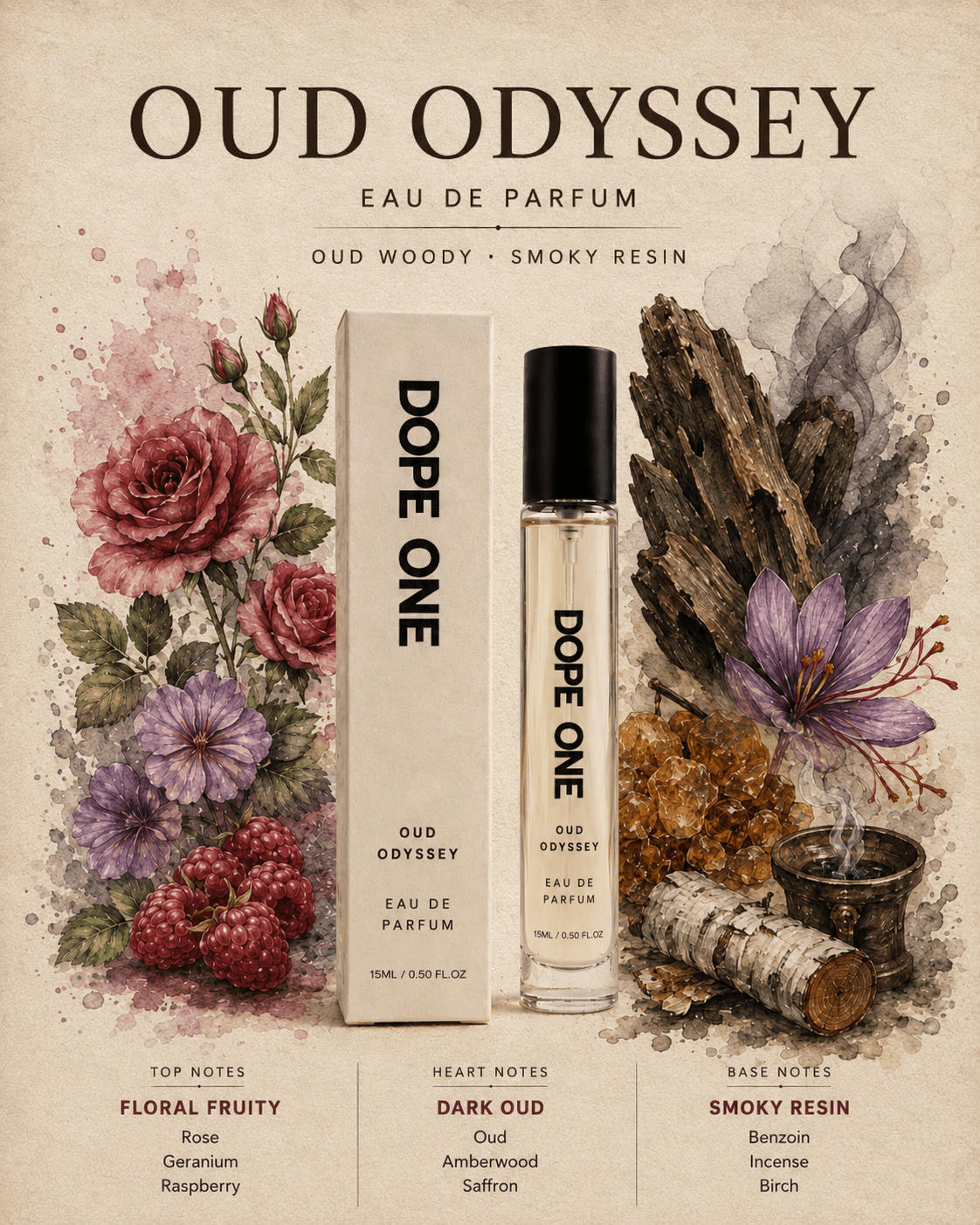
Oud Odyssey
Smoky oud, raspberry-saffron, benzoin
₹329
View →
The starting point for this category in the Indian D2C space. Smoky oud with a raspberry-saffron opening, incense and rose at the heart, dry oud-wood and benzoin at the base. If that note stack reads familiar, it should — the olfactory territory is the same. The difference is not in the structure but in the calibration of the opening.
In Ombre Nomade, the raspberry at the top is the fragrance's most memorable move and its most climate-vulnerable one. On humid Indian skin, the fruit-smoke accord that makes the original distinctive can read thinner than expected. In Oud Odyssey, the opening materials were chosen specifically for their behaviour at Indian ambient temperatures — the raspberry-saffron combination holds its shape on humid skin rather than collapsing into vague sweetness, because the selection of the specific molecules was made with the heat context in mind.
This is not a marketing claim about "heat calibration." It is a specific formulation decision: certain raspberry ketone derivatives hold in high ambient temperature better than others; the choice between them is the choice between a fragrance that works in Indian summer and one that doesn't. The saffron in the Oud Odyssey opening is similarly heat-stable: a spice note that provides warmth without evaporating fast.
The heart-to-base transition happens more quickly in Indian heat than the European wear log for any oud suggests, including Oud Odyssey. This is not a failure; it is climate. The incense-rose heart arrives within the first twenty minutes in summer conditions; the dry oud-benzoin base is present from the thirty-minute mark. What this means practically: in Indian wear, Oud Odyssey is primarily a base-forward fragrance faster than in European conditions. The base is the good part. The base is what lasts on your collar the following morning.
On Indian fabric in summer, the dry-down trace is where the fragrance earns its full case. The oud-wood and benzoin together produce a trail that reads distinct and dark without becoming harsh — the balance between the oud and the benzoin prevents the former from sharpening into an aggressive medicinal register, which is the failure mode of cheap oud formulations.
Honest limitation: this is not a fragrance for every context or every person. It expects confidence from the wearer. A first-time oud buyer who isn't sure whether they like heavy fragrances should not start here — they should start somewhere lighter and come back. Oud Odyssey rewards a wearer who has already decided they want presence and gravity, not one who is still testing whether that is what they want.
Reactions split into exactly two camps: people who need to know what it is, and people startled that a fragrance can have this much character. Nobody ignores it. Next morning, the better question is what wasn't left on the collar.
Oud Odyssey in the shop · ₹329
2. ALT Fragrances Nomadic Shadow
A US-based house with one of the strongest community reputations for Ombre Nomade territory compositions. Nomadic Shadow carries heavier incense than the original, slightly less raspberry in the opening, and the same oud-benzoin base architecture. Community consensus across multiple fragrance forums puts it as the closest compositional match to the original available at a lower price point.
The India-specific friction: ALT Fragrances ships from the United States, which means customs duty, a two-to-three week delivery window, and the risk of the package sitting at customs for additional time. After shipping and duty, Nomadic Shadow lands in India at roughly ₹4,000–6,000 depending on the bottle size and the duty calculation — considerably less than the original but meaningfully more than the Indian D2C alternatives.
What the premium buys: the opening character of Nomadic Shadow is closer to the original than DOPE ONE Oud Odyssey, for buyers to whom the specific raspberry-smoke opening is the primary brief. If the first twenty minutes of Ombre Nomade is what you are trying to replicate, Nomadic Shadow makes that case. If the full-wear experience in Indian conditions is the brief, an Indian-formulated oud is a more practical answer.
Practical note: buy directly from ALT Fragrances' website for guaranteed authenticity. Grey-market availability in India for this fragrance is not established enough to trust secondary sources.
3. Bombay Oud by Euro Arabian
Indian-formulated and widely available, ₹1,500–2,500 depending on retailer and bottle size. This is the heaviest option on this list — the rose-saffron- incense structure is present but the overall read sits closer to a traditional oud profile than to the raspberry-modern shape of Ombre Nomade. Where the original uses raspberry to give the oud an unexpected lightness at the opening, Bombay Oud leans into the weight.
Who should consider this: buyers who liked the incense-oud base of Ombre Nomade but found the raspberry opening too modern or too light. Buyers who want oud density more than oud novelty. Buyers for whom the ₹1,500–2,500 price point is the primary consideration and who are comfortable with a more traditional oud character.
Honest trade-off: the rose in Bombay Oud reads more prominent and more literal than in the original, where it functions as a structural colour rather than a stated note. The composition is more predictable — the "heavy oud for Indian winter occasions" brief is exactly what it delivers, without surprise or novelty. That is exactly what some buyers want.
Performance in Indian heat: the traditional oud base holds well in summer, but the heavy overall composition can become overpowering in 40°C outdoor conditions. Best in the October-to-March window, in air-conditioned settings, or for evening occasions where the density is an asset rather than a liability.
4. Montale Oud Pashmina
French niche house with a serious oud line. Oud Pashmina sits in the oud-rose-incense family but at a different orientation: more rose-forward, sharper incense, less raspberry, the oud smoother and less tarry than in Ombre Nomade. Where the LV version uses fruit-smoke as a signature move, Oud Pashmina uses rose-smoke as its structural identity.
Available in India through niche fragrance retailers at roughly ₹8,000–11,000 for 100ml. At that price point it sits between the Indian D2C tier and the original, and the honest assessment is that the higher price does not necessarily deliver a higher-quality experience for an Indian buyer — it delivers a different one. Montale is a French house with distribution in India; the supply chain is clean.
Who should consider Oud Pashmina: buyers who loved Ombre Nomade primarily for the rose component and want that character more pronounced; buyers who found the raspberry in the original slightly odd or too casual; buyers already familiar with Montale's oud line and its specific character. For buyers new to oud who are using Ombre Nomade as a reference point, Oud Pashmina may feel like a sideways move rather than a substitute.
5. Faun Walk Stoic
Indian D2C at the ₹1,499 tier. Captures the oud-smoke structural shape competently for the price. The olfactory shorthand is correct: smoky, dark, resinous. The execution is thinner — the incense does not have the same depth as in the original, the benzoin base is less distinct, and the raspberry opening is approximated rather than composed.
The honest case for Stoic: if budget is the primary constraint and the priority is owning something that lives in the smoky-oud family for ₹1,499, Stoic delivers that brief. The longevity on fabric is lighter than the alternatives above — the trail does not persist the same way — but for the purpose of exploring whether you like the profile before committing to a higher-price option, it is a legitimate entry point.
Who should not use Stoic as an Ombre Nomade alternative: anyone whose primary brief is the opening raspberry-smoke accord. Stoic's interpretation of that accord is the weakest of the alternatives on this list. The base is more solid than the heart; buy it for the base or buy it for the price, not for the opening.
| Fragrance | Profile | Longevity | Price | Best for |
|---|---|---|---|---|
| DOPE ONE Oud Odyssey | Smoky oud, raspberry, benzoin | 5–6+ hours on fabric | See shop | Best for Indian heat overall |
| ALT Nomadic Shadow | Incense-heavy oud, rose | 5–6+ hours on fabric | ₹4,000–6,000 (with shipping) | Best opening match to original |
| Bombay Oud (Euro Arabian) | Traditional oud, rose, saffron | 5–6+ hours on fabric | ₹1,500–2,500 | Best for oud weight; Oct–Mar |
| Montale Oud Pashmina | Rose-smoke oud | 5–6+ hours on fabric | ₹8,000–11,000 | Best for rose-first preference |
| Faun Walk Stoic | Smoky oud, thinner base | 3–4 hours on fabric | ₹1,499 | Best budget entry point |
How oud performs on Indian fabric vs skin
The fabric vs skin distinction matters more for heavy oud compositions than for almost any other fragrance family. On skin, oud materials behave well in heat — they are among the most heat-stable materials in perfumery — but the projection changes character as the skin temperature rises. On fabric, the story is entirely different.
Cotton holds oud dry-down for a very long time — well past the skin wear. The benzoin-oud trail of Ombre Nomade or Oud Odyssey on a cotton dress shirt is detectable the following day in a way that would surprise most wearers who only track their wrist. The collar of a collared shirt is the single best carrier of the dry-down in Indian conditions; apply one spray to the inside of the collar for a fabric longevity that outperforms skin wear significantly.
Silk and synthetic fabrics behave differently. Silk absorbs differently than cotton and does not hold the oud dry-down as cleanly; the note can read muddier. Synthetic polyester fabrics — common in Indian occasion wear — can hold fragrance but also trap heat and body odour under it, which interacts with the oud in unpredictable ways. For oud fragrances on occasion wear, test the fabric interaction before committing to a social context.
The morning-after test is the most reliable longevity indicator for any oud composition in Indian conditions. Pick up yesterday's shirt the following morning and smell the inside of the collar. The answer you find there — not the three-hour wrist test — is what determines whether a fragrance works for your skin chemistry, your fabric choices, and your climate context.
One more fabric note: don't spray oud directly onto white shirts. The oud-benzoin base can stain light-coloured fabric with a faint warm tinge that is barely visible when dry but marks the fabric permanently. Spray onto skin first; let the fragrance settle for five minutes; then put on the shirt. The off-gassing from skin contact is enough to transfer the dry-down to the inner collar over time without direct spray contact.
Who should not buy the smoky-oud profile
Every fragrance guide lists who should buy the product. Few of them list who shouldn't. That omission is where the trust gets spent, because the wrong recommendation costs the reader real money and a bad experience.
First-time fragrance buyers. Smoky oud is not where you start. It is where you arrive after you have worn enough fragrances to know whether you want presence and character or lightness and discretion. A first-time buyer who puts on Ombre Nomade or Oud Odyssey in an enclosed space and finds it overwhelming has not learned that they dislike fragrance — they have learned that they were not ready for this category. Start with clean aquatics or citrus-woods; come back to oud in six months.
Gym and active wear. Heavy oud and sweat are not a combination that ends well. The incense-base of this profile amplifies with body heat and humidity in a way that becomes oppressive in a high-exertion context. There is no Indian summer gym scenario where a smoky oud is the right fragrance. Save it for contexts where projection is a deliberate choice, not a byproduct of movement.
Peak summer outdoor events. A noon wedding ceremony in a tent in June is not the context for a heavy oud. The guests sitting next to you will know this before you do. Oud is an evening and indoor fragrance in Indian peak summer; the weight that reads impressive at a November reception becomes oppressive in a 40°C outdoor setting. Choose by occasion and temperature, not just by what you like the smell of.
The office with thin walls.Oud projection in an air-conditioned office means your colleagues know what you're wearing from two desks away. That is not inherently wrong — but it requires that you are the person who made a deliberate choice to be present in a room rather than the person who didn't realise they were overwhelming it. One spray, on skin only, for office wear. Never two.
Anyone who wants to blend in. Smoky oud does not blend in. That is not a limitation of the profile; it is the profile. If you want to wear fragrance without drawing comment, choose something quieter. Oud is the fragrance you wear when you have already decided to be noticed.
The Indian oud landscape in 2026
India has had a relationship with oud for centuries — through the attar tradition, through Middle Eastern trade routes, through the cultural weight of agarwood in religious and ceremonial contexts. What has changed in the last decade is the arrival of the modern Western oud format: EDP-concentration spray fragrances that use oud as an ingredient within a designed composition rather than as a traditional oil applied directly.
The Indian oud market in 2026 occupies three tiers. The first is the traditional attar tier — concentrated oud oils sold in roll-on or dabber format, often without modern synthetic materials, deeply rooted in the Middle Eastern and South Asian tradition. These can be expensive at the high end (genuine Malay or Hindi oud oils cost significantly more per gram than Ombre Nomade) or surprisingly affordable at the mass end. They perform differently from modern spray compositions.
The second tier is the Indian D2C modern oud — brands like DOPE ONE, Faun Walk, Bombay Oud, and several others composing in the Western EDP format using imported aroma chemicals, sometimes with genuine oud-wood extracts and sometimes with oud-wood accord materials that approximate the character without the cost. The quality range in this tier is wide; the best are genuinely good; the worst are thin interpretations that share only the olfactory vocabulary of oud without the structural substance.
The third tier is imported niche — houses like Montale, Amouage, Tom Ford, and the Louis Vuitton collection, sold through authorised channels at premium prices. These compositions use the highest-quality ingredients and have the clearest supply chains. The price reflects the ingredients, the brand, the import duty, and the distribution margin — all of which are real costs. Whether the buyer specifically needs those costs in the bottle is the honest question.
Ombre Nomade occupies the top of the third tier. DOPE ONE Oud Odyssey sits in the second tier. Bombay Oud and Faun Walk Stoic sit at the accessible end of the second tier. The attar tradition is parallel to all of this, not competing with it — a different format, a different application method, a different cultural register. Understanding which tier you are buying from and what that tier delivers is the foundation of an honest purchase.
If the question is broader — which families perform best in Indian heat across all fragrance categories, not just oud — the guide to long-lasting perfumes for men in India covers the full landscape.
How to wear smoky oud in Indian heat
Evening, not morning, for first-time wearers. Oud has gravitational weight in a way that most fragrances don't. A 9 AM application of a heavy oud in a summer city means your nose is adapting to it by 10 AM while everyone else in your environment is encountering the full projection. By the afternoon your nose has normalised to it; your neighbours in the office lift have not.
Two sprays is the ceiling for indoor wear. One for office settings where projection is a liability; two for evening contexts where presence is the brief. Three sprays is the territory of making a statement that the room did not ask for — save it for very specific occasions and very large spaces.
Apply to the neck below the jawline, not above it. Heat from the body rises; the fragrance projects upward through the day rather than blasting outward from the start. The inner wrist is a secondary application point — useful for the intimate register of the dry-down, not for projection.
Apply thirty minutes before the occasion, not immediately before it. The opening of a heavy oud in an enclosed car or corridor is more aggressive than the same opening in an open space. Let the fragrance settle before entering a social context. The first twenty minutes are the loudest; after that the composition quiets into the heart and the social presence becomes easier to manage.
Seasonal adjustment: in Indian summer at 40°C, reduce to one spray and apply to fabric (inside collar) rather than skin for a cleaner, longer dry-down trail without the intense opening projection that heat amplifies. In winter, the full two-spray on-skin application is appropriate and produces the fragrance's best performance.
The honest trade-off for each alternative
Every substitute involves something you gain and something you give up. The honest guide is the one that names both.
DOPE ONE Oud Odyssey vs the original:You gain Indian-heat calibration, a clean supply chain, and a price that does not require a boutique visit. You give up the specific raspberry-smoke opening character and the brand context of an LV bottle. For most Indian buyers wearing this in real conditions, the gain outweighs the loss. For those to whom the specific opening is the entire point, it doesn't.
ALT Nomadic Shadow vs the original: You gain the closest available opening match and a well-established composition quality. You give up domestic delivery, a significant portion of the price advantage, and the ability to smell before you buy. The international shipping friction is real for the Indian buyer.
Bombay Oud vs the original:You gain a significantly lower price and a more traditional oud character. You give up the modern raspberry- smoke novelty that makes the original distinctive. This is the right choice if you want oud depth more than Ombre Nomade's specific personality.
Montale Oud Pashmina vs the original: You gain a genuinely different rose-oud composition with strong house credentials. You give up the raspberry-smoke opening entirely. This is not a substitute in the strict sense; it is a different fragrance in the same family that some buyers will prefer. The price premium over Indian D2C requires honest evaluation.
Faun Walk Stoic vs the original: You gain entry into the olfactory family for ₹1,499. You give up depth, longevity, and the composition quality of the alternatives above. The honest use case is exploration and budget constraint, not a straight substitute.
Common questions
- What is the best alternative to Louis Vuitton Ombre Nomade?
- DOPE ONE Oud Odyssey is the closest Indian-formulated match for Indian heat performance — same olfactory territory, calibrated for subtropical conditions. For opening-character match, ALT Fragrances Nomadic Shadow has the strongest community reputation, though it ships from the US. The right pick depends on whether the brief is Indian-heat performance or opening-note match.
- Is Louis Vuitton Ombre Nomade worth the price in India?
- Ombre Nomade retails around ₹26,000+ in India, is boutique-only, and has a documented counterfeit problem in Indian e-commerce. The composition is genuinely original. Whether the price is justified depends on whether the specific raspberry-smoke opening and LV brand context are primary considerations — for most Indian buyers, the Indian-formulated alternatives at a fraction of the price close the olfactory gap without the distribution friction.
- What does Louis Vuitton Ombre Nomade smell like?
- A smoky raspberry opening with saffron warmth, an incense-rose heart, and a long oud-wood-benzoin dry-down. The unusual move is the raspberry, which gives the composition an unexpected fruit-leather quality at the opening. After the first hour it reads dark, dry, and resinous — a heavy oud composition built for cold-weather wear.
- Are there Indian perfumes similar to Ombre Nomade?
- Yes. DOPE ONE Oud Odyssey is the strongest Indian-formulated match at the niche tier, built with the same olfactory architecture and calibrated for Indian heat. Bombay Oud by Euro Arabian is a heavier, more traditional interpretation. Faun Walk Stoic is the lowest-price entry point. None is identical to the original; all hold the smoky-oud DNA.
- Does Ombre Nomade last long in Indian heat?
- The base — oud-wood and benzoin — is heat-stable and holds well in Indian conditions. The opening raspberry-smoke accord compresses faster in high ambient temperatures, so the early transition to the heart and base happens more quickly than in European wear. The fabric longevity is strong; the morning-after collar test is where this fragrance shows its durability.
- What is the closest Indian alternative to Ombre Nomade?
- DOPE ONE Oud Odyssey is the closest for Indian heat conditions: same raspberry-saffron-incense-benzoin architecture, formulated to hold the opening accord in subtropical temperatures. The opening character is slightly different from the original — drier, less fruit-forward — but the structural framework is the same and the climate calibration is more appropriate for Indian wear.