Long Lasting Perfumes for Men in India: A Formulator's Honest 2026 Guide
Transparency: we formulate DOPE ONE Born Bad. Every fragrance here, including ours, is judged on the same criteria: Indian heat performance, fabric longevity, and fidelity to the original's character. Where ours falls short, we say so.
Indian summers are the world's most efficient fragrance critic. A juice that wore confidently in a Stockholm office in February surrenders to a March morning commute in Chennai. Not because the formula changed. Because the climate doesn't negotiate. The citrus opening that charmed a department store counter collapses before you have crossed the first signal. The base note meant to anchor everything bakes off the skin and goes. The famous label becomes irrelevant within the hour.
What survives Indian conditions is a specific subset of fragrance design: EDP concentration, base notes built from heat-stable materials, and a formulation brief written for subtropical skin rather than retrofitted from a European brief. This guide covers seven picks that hold up in real wear — not lab ratings, not press-release longevity claims, not the number printed on the brand card.
A fair warning before the list: no precise skin-hour longevity claims appear here for any product, ours or anyone else's. Every competitor page in this category reports numbers between eight and fourteen hours on skin. Nearly all of them are wrong for Indian conditions. The honest framing is fabric longevity, qualitative performance, and seasonal context. That is what actually guides a buying decision that survives the first week of wear.
What "long lasting" actually means in Indian heat
Fragrance longevity has three distinct phases on skin, and most reviews — Indian and international — collapse all three into a single number. That single number obscures the only part of longevity that matters in subtropical conditions.
The opening phase (first fifteen to thirty minutes) is the least reliable measure of anything. Openings fade on every skin in every climate; the alcohol vehicle evaporates fast regardless of formulation quality. A spectacular opening followed by nothing is a common complaint in Indian summer because the top notes leave with the alcohol and there is nothing underneath to hold them in place.
The heart phase is where Indian heat first separates good formulations from weak ones. At 38°C with sixty percent humidity, skin temperature is high enough to accelerate the evaporation of middle-register materials substantially faster than European reviews describe. A floral heart that holds for three hours in a Paris spring holds for thirty minutes in a Mumbai May. Heart-dominant fragrances — the ones built around a single prominent central note — typically perform worst in Indian conditions because their most important material disappears fastest.
The base phaseis what Indian heat rewards. Oud, leather, amber, vetiver, resinous wood, ambroxan — these materials have high molecular weight and low volatility. Heat actually accelerates their initial projection in the first two hours: they read bigger, louder, and warmer in Indian summer than European wear logs suggest. But they leave significant residue on fabric and skin hair that outlasts the lighter materials by many hours. The base is the only reliable part of a fragrance's performance story in Indian conditions.
The most accurate longevity test for Indian conditions is not how many hours a fragrance lasts on the wrist but what the shirt collar smells like the following morning. The fabric answer almost always beats the skin answer by several hours. A fragrance that reads as nothing on the skin by seven in the evening may still be present and identifiable on the shirt collar at noon the next day. This is the collar test, and it is more useful than any stopwatch.
The practical implication: when buying a fragrance specifically for Indian heat, buy for the base note pyramid. The opening is the advertisement; the base is the product.
Concentration explained: EDT, EDP, and Extrait for Indian conditions
The numbers matter. Eau de toilette (EDT) carries 8–12% fragrance oil in an alcohol vehicle. Eau de parfum (EDP) carries 15–22%. Extrait de parfum carries 25–40% or higher. That ten-point gap between EDT and EDP produces a materially different result in Indian heat — not just a different label.
At high ambient temperatures, fragrance oil disperses faster from skin as the alcohol vehicle evaporates. An EDT at 10% oil concentration in a 40°C environment puts a fraction of its theoretical material onto your skin because the lighter molecules leave with the alcohol before the oil has time to anchor. An EDP at 20% starts with twice the oil load. Even after aggressive initial evaporation, there is still material remaining. Extrait de parfum at 30–40% is the extreme case: even on a harsh Indian summer afternoon, enough material clings to skin and fabric for genuine, demonstrable longevity.
The catch the packaging never mentions: concentration alone does not guarantee performance. A poorly formulated EDP built entirely on light, heat-sensitive top and heart materials will still underperform in Indian conditions. An EDP labelled as such but formulated at 15% with a floral heart and a musk base will fade by midday in Bengaluru in April. Concentration is necessary but not sufficient. The base structure is the co-determining variable.
A second note that the packaging also omits: high-concentration fragrances project more aggressively in heat than their European wear descriptions suggest. A two-spray EDP on skin heated by a midday outdoor lunch in Hyderabad reads significantly differently in a crowded lift than in a Stockholm boardroom. One spray is often the right answer for Indian daytime wear, even when longevity is the priority. Overshooting concentration is how you become the reason someone opens the window.
The Arabic attar tradition — concentrated perfume oil applied without alcohol, typically behind the ear and on the wrists — has operated on South Asian and Middle Eastern skin for centuries precisely because of this logic. High-concentration oil on a warm pulse point projects steadily and consistently, without the initial alcohol flare and without the rapid evaporation that follows it. Modern EDP fragrances built with a serious base structure can approximate this behaviour. Most EDT formulations cannot.
Practical recommendation for Indian buying decisions: EDP as the floor. Extrait if you want to apply less and get the same result. EDT for fragrances you know will be worn in cooler months or heavily air-conditioned settings only.
Which fragrance family survives Indian heat
Olfactory family is the single strongest predictor of Indian heat performance. Not brand. Not price. Not country of manufacture. The chemical composition of the base determines everything.
Leather and tobacco perform best in heat. Leather accords and tobacco extracts have high molecular weight and are naturally heat-stable; they are derived from or composed to mimic materials that real leather develops when warm. In Indian summer they project further and with more presence than European wear logs describe — the heat amplifies them. The caution is calibration: leather that is elegant in October becomes oppressive in outdoor July. The right occasion is critical; the profile itself is robust.
Oud and resinous bases are the ancient answer to South Asian heat. Oud has been worn on Indian and Middle Eastern skin for centuries because the chemistry works: its aroma compounds are dense, heat-resistant, and long-lasting on both skin and fabric. The heat accelerates projection in the early hours and the base outlasts almost everything else. The limitation is boldness: oud is not a subtle family, and the heat magnifies what is already a demanding register.
Woody amber and musks are the all-season backbone. Ambroxan, cetalox, and synthetic musks have high molecular weight and moderate-to-high heat stability. They provide the longevity platform underneath lighter notes and perform reliably across Indian seasons. A fragrance built on a woody-amber base will outlast one built on a floral or citrus base even at identical concentration.
Smoky-fruit (Aventus territory) is interesting: the pineapple and blackcurrant notes that define this family are heat-sensitive, but the birch and ambroxan base underneath is not. The failure mode is a sweet, cloying opening that overwhelms in peak summer heat, followed by a recovery in the base that holds well. Formulated specifically for heat stability, the opening can be made to hold longer. Formulated for European conditions without that brief, the opening collapses fast and the base arrives unsupported.
Aquatic and citrus are the honest concession: they are not longevity families in Indian heat. Bergamot, citron, and neroli have extremely low molecular weight and leave skin within minutes at high ambient temperature. Aquatic ozonic accords are designed for freshness, not persistence. Both families still serve a purpose — freshness in a short window that leather and oud cannot offer — but choosing them for longevity is choosing the wrong tool for the job. If freshness is the brief, they are right. If longevity is the brief, look at the other three families.
Florals and light woods sit in the middle. A floral heart over a woody-amber base will typically hold on skin for two to three hours in Indian conditions, with the base extending several more hours on fabric. The base determines the fabric story regardless of how prominent the floral is in the opening.
The seven picks worth knowing
Four DOPE ONE options, one for each major heat-stable olfactory family. Three honest external comparisons. For each: olfactory profile, performance in Indian conditions, honest limitation, and price. Longevity is described in fabric terms, not skin-hour claims.
1. Leather — DOPE ONE Born Bad
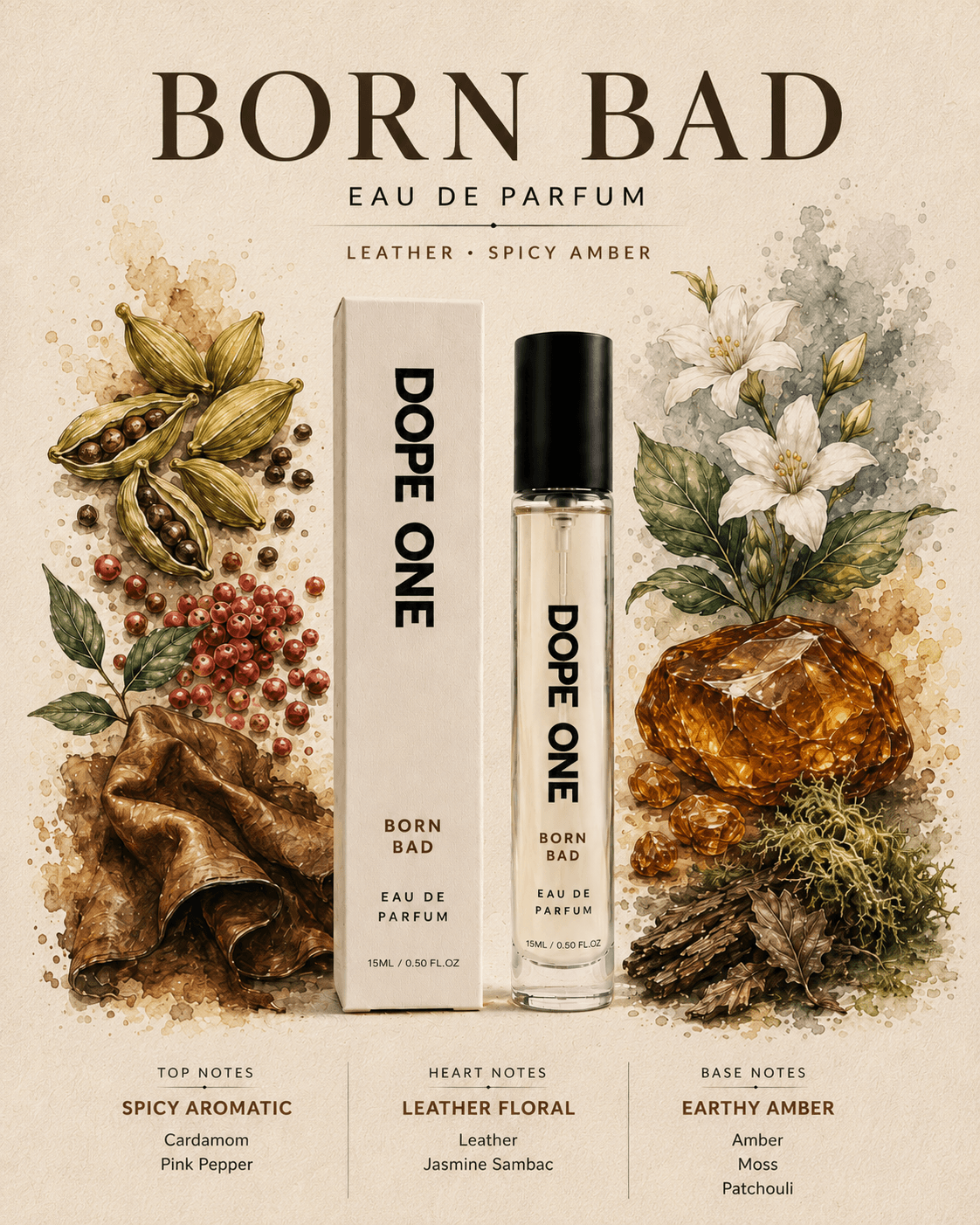
Born Bad
Leather, cardamom, patchouli, amber
₹329
View →
Across a dinner table, every time the air moved, the same glance came back in my direction. Nobody said a word. Leather doesn't collect compliments here — it collects attention. When someone finally does speak, it's never 'what fragrance is that.' It's 'you smell expensive.'
2. Smoky-fruit (external) — Armaf Club de Nuit Intense Man
3. Oud — DOPE ONE Oud Odyssey
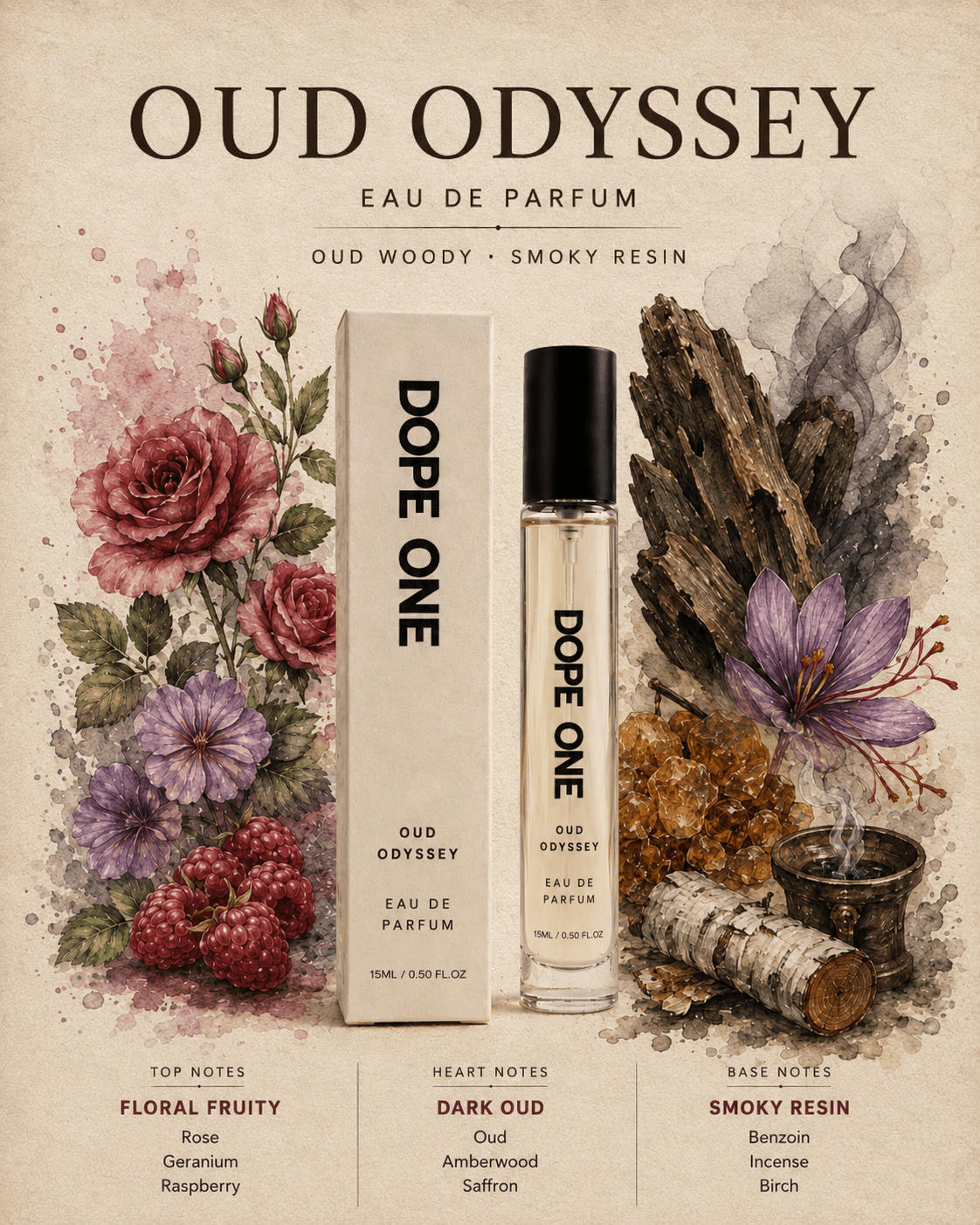
Oud Odyssey
Smoky oud, raspberry-saffron, benzoin
₹329
View →
4. Fruity-woody (external) — Afnan Supremacy Collector's Edition
5. Smoky-fruit — DOPE ONE Quite Boss
6. Aquatic (external) — Rasasi Hawas Ice
7. Citrus-amber — DOPE ONE Apex Citruss
| Fragrance | Profile | Longevity | Price | Best for |
|---|---|---|---|---|
| DOPE ONE Born Bad | Leather, cardamom, patchouli, amber | 5–6+ hours on fabric | ₹329 | Evenings, cooler months, air-conditioned settings |
| Armaf Club de Nuit Intense Man | Smoky pineapple, birch, woody drydown | 5–6+ hours on fabric | ₹2,500–3,500 (2026) | Community standard, moderate conditions |
| DOPE ONE Oud Odyssey | Smoky oud, raspberry-saffron, benzoin | 5–6+ hours on fabric | ₹329 | Year-round, weddings, confident daily |
| Afnan Supremacy Collector's Edition | Fruity-woody, dense drydown | 5–6+ hours on fabric (dry conditions) | ₹3,500–4,500 (2026) | October to March, Absolu shape |
| DOPE ONE Quite Boss | Pineapple, birch smoke, clean amber | 5–6+ hours on fabric | ₹329 | Office, wedding season, daytime |
| Rasasi Hawas Ice | Aquatic, ozonic, light musk | 3–4 hours on fabric | ₹2,500–3,000 (2026) | Freshness brief only — not a longevity pick |
| DOPE ONE Apex Citruss | Bergamot, pink pepper, amber, resin | 5–6+ hours on fabric | ₹329 | Summer daytime, office mornings |
How Indian seasons change your fragrance choice
There is no fragrance on this list that is right for every Indian month. The seasonal variable is real and regularly ignored by guides written for European climates. Here is the honest seasonal map for Indian conditions.
April to June — peak heat, 38–45°C: Base-heavy families are the most reliable starting point. Oud, leather, amber, vetiver — the heavy, low-volatility materials. Sweet gourmands and heavy florals amplify into cloying at high temperatures, especially with humidity; the sugar read becomes overwhelming on warm skin. Fresh and aquatic fragrances offer a short window of genuine freshness but fade fast. The practical rule for peak summer: buy for the base note profile, not the opening. The opening is entertainment; the base is the purchase.
Caveat for outdoor occasions in peak heat: even the heat-stable families can overwhelm in outdoor settings above 40°C if applied at normal indoor quantities. One spray is the rule outdoors. Two sprays are for interiors and evenings.
July to September — monsoon, sustained humidity: Humidity changes the equation significantly. Heavy oud and leather can become overwhelming in enclosed spaces when humidity combines with body warmth. The heat amplification that works in dry conditions overshoots in humid ones. Mid-range families perform best in this window: woody-aromatic, moderate florals, light musks, smoky-fruit at moderate projection. Quite Boss and Apex Citruss tend to hold well through monsoon. Heavy base fragrances are better reserved for air-conditioned contexts rather than outdoor humid wear during this period.
October to February — the full shelf opens: The fragrances that were too much in July become precisely right in November. Leather fragrances that projected aggressively in August project elegantly in October. Delicate florals that collapsed in summer hold for hours. This is the window where Born Bad and Oud Odyssey reach their best performance and where the European wear logs start to feel approximately accurate again. Wedding season — October through February — is the natural context for the stronger end of the shelf.
The coastal versus northern India variable:Mumbai and coastal Karnataka humidity is sustained year-round. Fragrance behaviour there is closer to the monsoon window even in January; the heavy-base, high-projection fragrances require a lighter hand. Bengaluru's altitude softens the summer peak; the cooler evenings allow base-heavy fragrances year-round. Chennai heat in March behaves like northern India in May. The Delhi formulation bench represents the extreme case — 45°C dry heat — so fragrances tested there tend to perform in most Indian conditions, with coastal humidity as the secondary variable to calibrate.
How to apply perfume for maximum longevity in Indian heat
Application technique accounts for a surprisingly large fraction of the longevity gap between two people wearing the same fragrance. These are not hacks. They are basic perfumery principles that the Indian climate rewards more visibly than European conditions do, because the performance margins are tighter.
Moisturise first, always. Fragrance molecules sit on the skin surface. Dry skin is a high-evaporation surface — the fragrance oil has no purchase and disperses into the air rather than adhering to anything. Moisturised skin provides a more stable base. Apply an unscented moisturiser ten minutes before any fragrance. Unscented matters: a scented lotion can interact with or clash against the fragrance above it, creating an unintended olfactory result that neither the lotion nor the fragrance intended. Unscented as a base is clean.
Pulse points, not everywhere. Inner wrist, neck below the jawline, behind the knees, inside the elbow. The blood vessels near the skin surface create consistent warmth that diffuses the fragrance outward continuously over hours. Avoid spraying directly onto the face or into hair in hot conditions — the alcohol vehicle is harsh when concentrated near eyes. Some wearers spray onto the chest under the shirt; the fabric then carries the dry-down even after the chest skin has cycled through its initial wear, which extends the effective longevity.
Spray onto fabric. The oldest and most reliable technique for Indian conditions. A single spray onto the inside of a collar or cuff adds measurable hours to any fragrance — the fabric retains the dry-down long after the skin has moved through the initial wear cycle. Cotton holds best. For white or delicate fabric, test on an inconspicuous area first; some formulations stain. Silk should be avoided entirely. The inside of the shirt cuff (rather than the collar, which is visible) is the more practical default. Fabric application is particularly effective with heavier base-note fragrances: the oud or leather that the skin finished with at hour four is still present on the cotton at hour nine.
Two sprays is the ceiling for Indian daytime.More sprays does not scale linearly to more longevity in warm conditions. Three sprays of an EDP in 40°C heat often performs worse than two because the top note overwhelms and the base never develops properly — the wearer's perception is saturated. Two sprays (one on skin, one on fabric) is the practical ceiling for Indian daytime wear. For formal evening settings where projection is welcome, three is the maximum. More than three is for cold climates or outdoor concerts where you are standing twenty metres from the nearest other human.
Layering for longevity: Applying a second, lighter fragrance over a heavier base can extend the pleasant top-note phase without disrupting the base-note longevity underneath. The classic Indian technique is an oud-based attar oil applied first, then a modern EDP over it. The attar anchors everything; the EDP provides the opening. This is not a trick — it is the functional reason the attar tradition developed. It works.
Where to buy in India — the counterfeit problem
India's fragrance market has a significant counterfeit tier. This is not a paranoid fringe concern; the community has documented extensively the presence of convincing counterfeits of Creed, Tom Ford, and several other premium houses in Indian grey-market channels. The counterfeit problem matters for this guide specifically: wearers who buy a counterfeit and get poor longevity assume the genuine fragrance is also weak. It is not. They are testing a different product.
For designer and imported fragrances: authorised boutiques, large luxury department stores, and brand-official e-commerce platforms. Parallel imports (products sourced from outside official Indian distribution channels) carry a provenance question. Grey-market online listings for premium fragrances at significant discounts are the primary risk channel. The test: if the price is 30–40% below the brand's own website, the question of why is worth answering before purchasing.
For Indian D2C brands: brand-direct is the cleanest channel. No counterfeit market exists for newer Indian D2C brands at this tier — the economics do not support it — so the concern is different: verify the brand is a real operating entity with a real product history before purchasing. Fragrantica community discussions on Indian brands are a reasonable calibration tool; a brand with multiple genuine reviews over multiple years is safer than one with no community history.
DOPE ONE is available directly at dopeone.in. No third-party sellers, no marketplace listings with uncertain provenance. The bottle that ships is the bottle that the bench produced.
The honest truth about "hours" claims
Every fragrance brand reports longevity in their most favourable possible context: low ambient temperature, low humidity, tested in conditions that match European spring or autumn. Those numbers are accurate for those conditions. They are frequently not accurate for 38°C Indian afternoons. The brands know this.
The Indian fragrance community has developed a working approximation over years of collective wear experience: halve the European longevity claim for skin wear in peak summer. Base notes lose very little; heart notes lose substantially more; top notes lose almost everything in high Indian heat. The collar test beats the wrist test as a longevity measure in warm conditions.
This guide does not report precise skin-hour longevity for any product because those numbers would be wrong in the conditions you will actually wear the fragrance. What it reports instead: olfactory profile, qualitative heat performance, fabric longevity guidance, and seasonal context. These are a different category of claim. They are ones that do not require inventing a number or testing in the most favourable possible environment and reporting it as a universal truth.
The Indian D2C tier in 2026
Five years ago, the mid-tier Indian fragrance market was dominated by thin "inspired-by" products with low oil concentrations, cheap fixatives, and formulations that captured the reference fragrance's profile in the first thirty minutes before collapsing. That is not an accurate description of the entire category in 2026.
Several Indian D2C houses have composed at genuine EDP concentrations using imported aroma chemicals from the same supply chains that support European niche houses. The gap between a ₹2,500 Indian D2C EDP and a ₹22,000 imported designer EDP is no longer primarily a formulation gap — it is a brand equity gap, an import-duty gap, and a distribution margin gap. The juice evaluation is now legitimate on its own terms, and the community has been validating that conclusion for several years.
What the D2C tier cannot replicate: brand heritage, the specific prestige of a particular bottle in a particular boutique, or the social signal value of a label that everyone recognises. If those are part of the purchase decision, no Indian D2C alternative addresses them and none pretends to. If the fragrance itself is the primary consideration — the performance, the profile, the longevity in actual Indian conditions — the tier now earns a serious evaluation. Not on nostalgia. On chemistry.
Common questions
- Which perfume lasts the longest for men in India?
- In Indian subtropical conditions, fragrances with EDP or extrait concentration and base notes of oud, leather, amber, or ambroxan outlast other families on fabric. Profile matters more than brand — a well-formulated leather or oud EDP will outlast a poorly-formulated extrait. DOPE ONE Born Bad and Oud Odyssey are formulated for Indian heat specifically.
- Is EDP better than EDT for longevity in Indian summer?
- Yes, materially. EDP carries 15–22% fragrance oil; EDT carries 8–12%. In subtropical heat the gap widens because the alcohol vehicle evaporates faster from warm skin, taking lighter molecules with it. For Indian summer, EDP is the floor. Extrait is the stronger option when projection requires a single spray rather than two or three.
- How can I make my perfume last longer in Indian heat?
- Apply to moisturised skin, target pulse points (inner wrist, below the jaw), and spray once onto fabric — a collar or shirt cuff. Fabric retains the dry-down several hours past skin longevity. Two total sprays is the practical ceiling for Indian daytime; more does not improve longevity and typically overshoots in warm conditions.
- Are Arabic or oud perfumes better for longevity in India?
- Generally yes. Oud, amber, and resinous-wood base notes have high molecular weight and resist heat-driven evaporation. This is why the attar tradition — concentrated oud oil on pulse points — has functioned on Indian and Middle Eastern skin for centuries. An EDP built on these materials outperforms one built on floral or citrus bases at identical concentration.
- Why does my perfume fade so fast in Indian summer?
- High ambient temperature accelerates evaporation of fragrance molecules from skin, particularly the lighter top-note and heart materials. Most fragrances are formulated for European climates where this is less severe. Fragrances with heavier base structures and higher oil concentrations retain significantly more performance in Indian heat — the base note is the only reliable longevity anchor.
- Which fragrance family lasts longest in Indian heat?
- Leather, oud, and woody-amber families consistently outperform citrus, aquatic, and floral families in Indian heat conditions. These base-heavy families have higher molecular weight materials that are more resistant to heat-driven evaporation and hold on fabric for considerably longer. Profile choice is the most important longevity variable, ahead of brand or concentration.
- Are Indian-made perfumes actually long-lasting in summer?
- The current generation can be, when formulated for the climate they ship into. Indian D2C brands composing at EDP concentration with imported aroma chemicals now deliver fabric longevity that historically only imported designer tier did. The evaluation should be on the formulation and base structure, not on country of origin. The collar test is the same regardless of where the bottle was made.